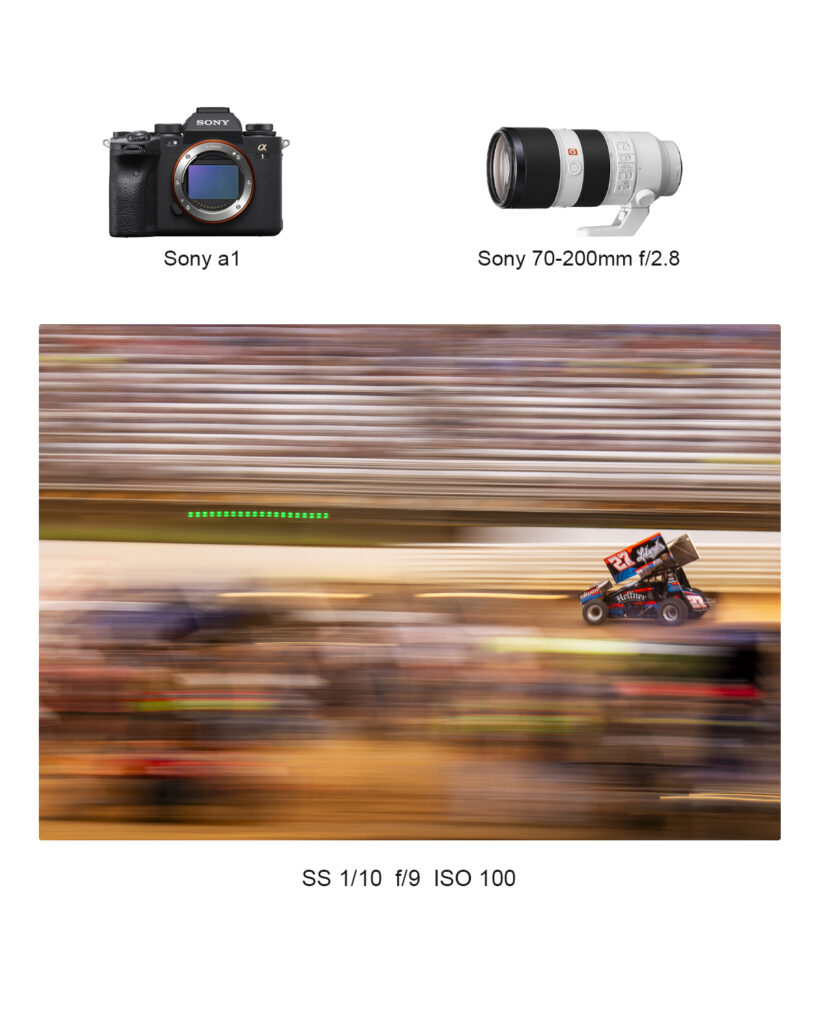
This image wasn’t created because of expensive camera gear—it was created by understanding light and using the right technique.
This photo was captured with a Sony a1, a 70-200mm f/2.8, and these settings:
Shutter Speed: 1/10 sec
Aperture: f/9
ISO: 100
The secret piece of gear that isn’t shown? A Variable ND Filter.
Best way to understand a Variable Neutral Density (ND) Filter is to think of the filter like a pair of sunglasses for your camera lens.
It reduces the amount of light entering the camera, allowing you to use much slower shutter speeds—even in bright daylight—without overexposing your image.
For this shot, the ND filter let me shoot at 1/10 of a second while panning with the car through the crowd in the foreground. That slow shutter speed creates all of the motion blur in the background while keeping the car relatively sharp, giving the image a true sense of speed.
I use a Variable ND with a built-in Circular Polarizer (CPL) because it not only controls the light but also helps reduce glare and reflections while maintaining rich colors and contrast. The result is a photo that looks dramatic straight out of the camera, requiring very little editing afterward in Adobe Lightroom.
The biggest takeaway?
The camera doesn’t create the effect—the ND filter makes the settings possible, and the photographer’s panning technique creates the final image.